Already changed your emails, but the numbers still don't add up?
Is the Email Really the Problem? Find Out What to Check Before You Change It Again.
Your opens and clicks can look fine while orders still fall. But that doesn't tell you whether the problem is the email, who received it, or what happened after the click.
What You Get For $49
A one-time review of selected Klaviyo flows, campaigns and customer activity, read alongside what your store sells and who buys from it.
Maybe you've already changed your emails and the numbers still don't make sense. Or maybe you're just getting started and want to know what deserves attention first.
We'll start with a 30-minute call about your store and buyers, then I'll review the available evidence without changing anything in your account.
You'll get written findings, a recorded walkthrough and one abandoned-checkout email draft, with the reasoning behind the first change I'd recommend, or the first thing I'd check before changing anything.
One-time Klaviyo Email Check
Your Price: $49, once
One call, written findings, a walkthrough and one email draft
One 30-minute call, then view-only access
Your findings arrive about two days after our call, in writing and on video.
Change One Thing, And Know Why
When an email number falls, the usual order is to rewrite a subject line or swap a template, send it, and wait to find out whether that was the cause.
When it wasn't, the number stays where it is and now there's one more change in the account to untangle.
This Email Check runs in the other order, starting with the question you want answered and reading the part of the account that bears on it.
Then it separates what the evidence shows from what's only a guess so far…
…so the change you make next is the one with a reason behind it:
how it's usually donethe guesswhere it leaves you
The Usual OrderChange FirstFind out afterward
SEE
A number drops on the dashboard
ASSUME
The emails must be the cause
REWRITE
New subject line, template or discount
SEND
It goes out to the list
WAIT
Watch the same dashboard
RESULT
No way to tell what moved it
This Email CheckRead FirstThen change one thing
ASK
The decision in front of you
READ
The flows and sends that bear on it
SORT
What's shown, what's possible, what's unknown
RESULT
One supported change, or one check
how the Email Check runswhat you receive
What That Means For Your Storeread this
It means the writing time, the sends and the discount margin go toward a change someone can tie to a cause…
…and the next job in your account is one job, small enough to hand to yourself or to whoever runs your email, with the reasoning written down beside it.
Sometimes that job is an email, and sometimes it's a setting, a segment or a flow that was never switched on, and the Email Check will tell you which.
Everything included
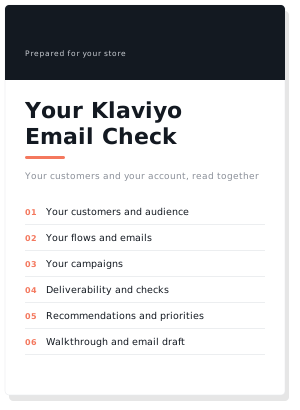
Your Klaviyo Email Check
(Call, findings, walkthrough and email draft)
One 30-minute call and a view-only reading of your account, with written findings, a recorded walkthrough and one abandoned-checkout email draft.
$49 once
Nothing renews
One payment of $49
One call, written findings, a walkthrough and one email draft
One 30-minute call, then view-only access
Your findings arrive about two days after our call, in writing and on video.
One Email Check Of The Part Of Your Account That Bears On Your Decision
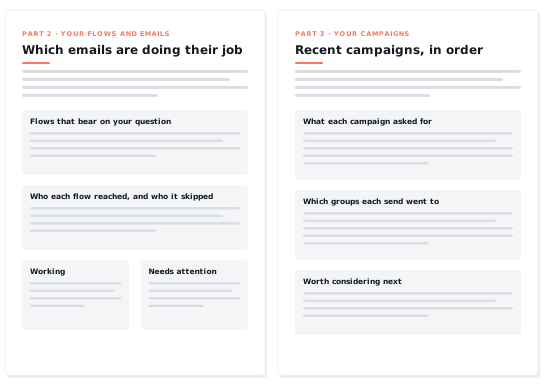
It reads up to three flows, up to three recent campaigns and about 30 days of sending against what you tell me on our call, and it hands back written findings, a recorded walkthrough and one abandoned-checkout email draft you can use whether or not you change anything else.
this is what you get
$49 Paid once, and nothing renews.
30 minutes On a call about your store, with your screen shared.
View-only Access, so nothing in your account changes.
The Call About Your Store
What you sell, who buys it and the one decision you want settled.
View-Only Access
You add me as a user who can read the account, so nothing gets edited or sent while I'm in it.
Up To Three Flows
Who entered, who was skipped and what each email asked.
Up to three of them, read with about 30 days of your sending around them.
Your Signals In Context
Purchase, engagement, deliverability and benchmark figures where your account has them, read for what they can and can't tell you.
Written Findings
One first priority, or one check to run first, with the evidence and the reasoning written beside it.
Walkthrough And Email
A recording that goes through the findings with you, and one abandoned-checkout email written for your buyers.
Before You Rewrite Another Email, Look at What These Klaviyo Screens Are Actually Telling You
One screen shows email revenue falling, while another gives your deliverability a “Good” score...
...Your benchmarks can even rate the same flow “Excellent” in one place and “Poor” in another.
So which number should you act on?
I'll walk you through the screens below, what each one measures, and what I'd check before changing an email.
You can look for the same things in your own account, whether or not you ever book the Email Check.
Start reading here
From the desk of Jason, Eternal Copy
Re: Which email to change first ( when your Klaviyo numbers stop agreeing with each other)
Dear store owner,
Klaviyo shows you an open rate, a click rate and a dollar figure for the revenue it credits to email, and as long as those three move together there's nothing to decide.
The decision shows up in the month they stop agreeing, when opens and clicks hold about where they were and the revenue figure drops, and nothing on that screen says which email to change.
This letter is about answering that from the evidence already in your own account, so the next change you make is one you can give a reason for.
Why The Report Can't Tell You Which Email To Change
...Klaviyo's reports count what happened after each email went out, so they show the open, the click and any order placed inside your attribution window, and they leave the cause for you to work out.
One Falling Number Can Have Several Different Causes Behind It, And Each Cause Asks For A Different Change
WHAT YOU'RE DECIDING
WHAT THE ACCOUNT SHOWS
WHAT THAT SUPPORTS
That's why the Email Check reads your account in three passes.
It Starts With A Conversation, Because The Same Number Means Different Things In Different Stores
First we talk for 30 minutes about what you sell, who buys it and the decision in front of you…
…then, once you've added me to your account with view-only access, I read up to three flows, up to three recent campaigns and about 30 days of sending against what you told me.
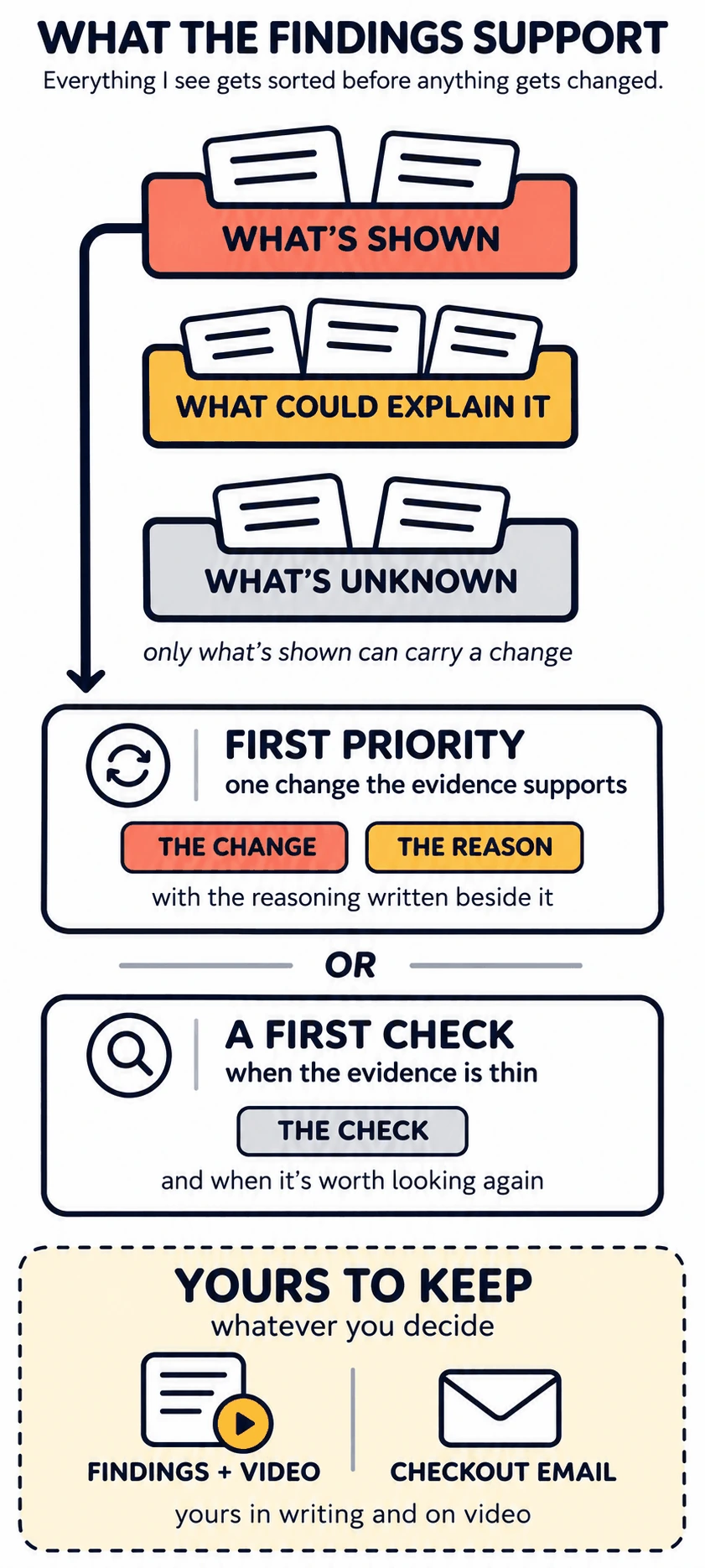
And by the time the written findings reach you, everything I saw has been sorted into what the evidence shows, what could explain it and what's still unknown, with one first priority at the top.
And Sometimes The First Priority Is To Leave The Emails Alone (Which Is Worth Knowing Before You Rewrite Them)
When a flow has too few people entering it to judge, or a test is too close to call...
...the move the evidence supports is a check.
The findings will say so and give the reason, and they'll show you what to look at and when it's worth looking again.
I'd rather tell you that than watch you rewrite a flow that hardly anyone has entered yet.
Here's What That Reading Looks Like On Real Klaviyo Screens
These screens come from different stores' accounts, and each one is a single moment in a single account, read the way the Email Check would read yours…
…in the same order we'd go through yours on our call, with your screen shared.
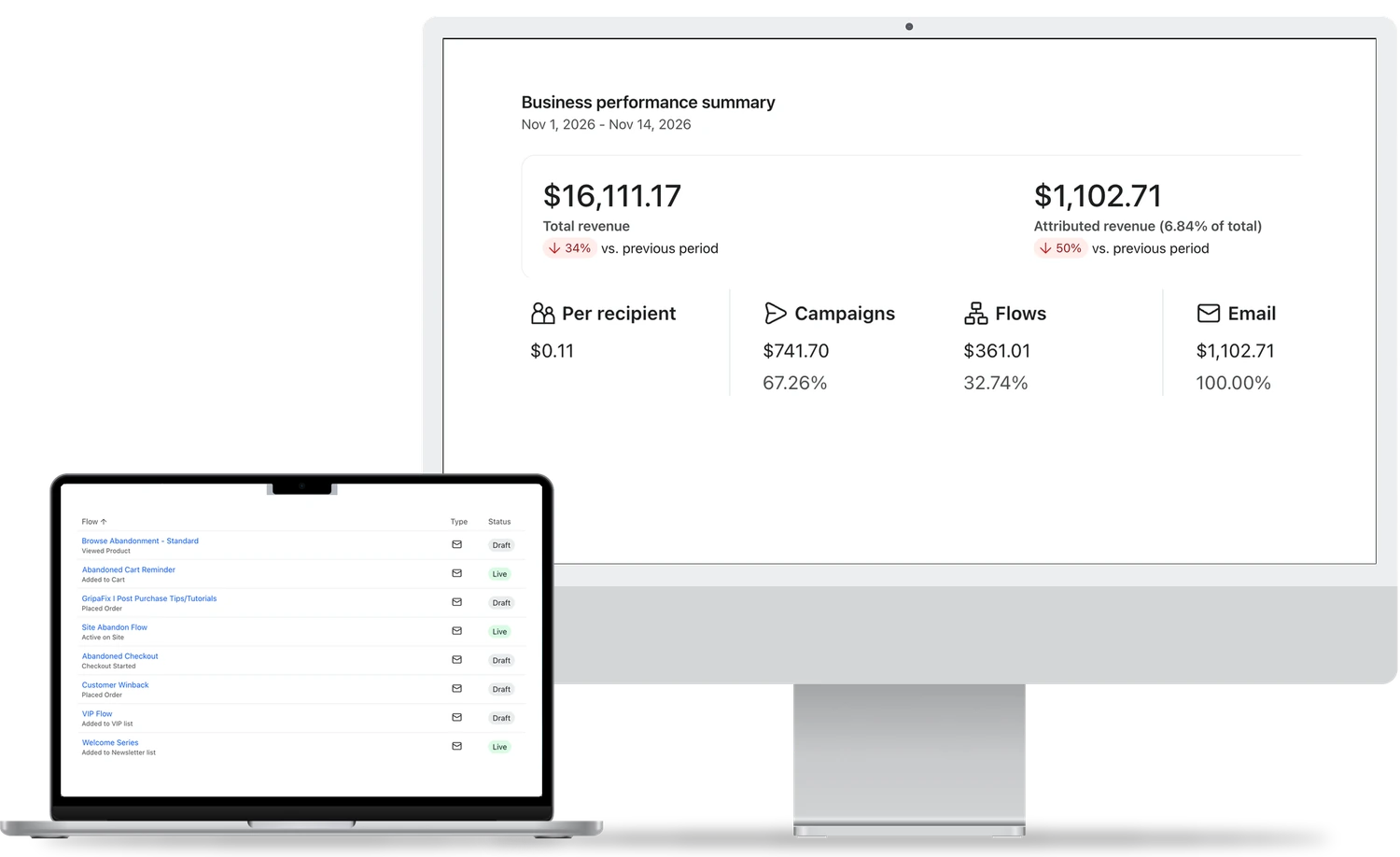
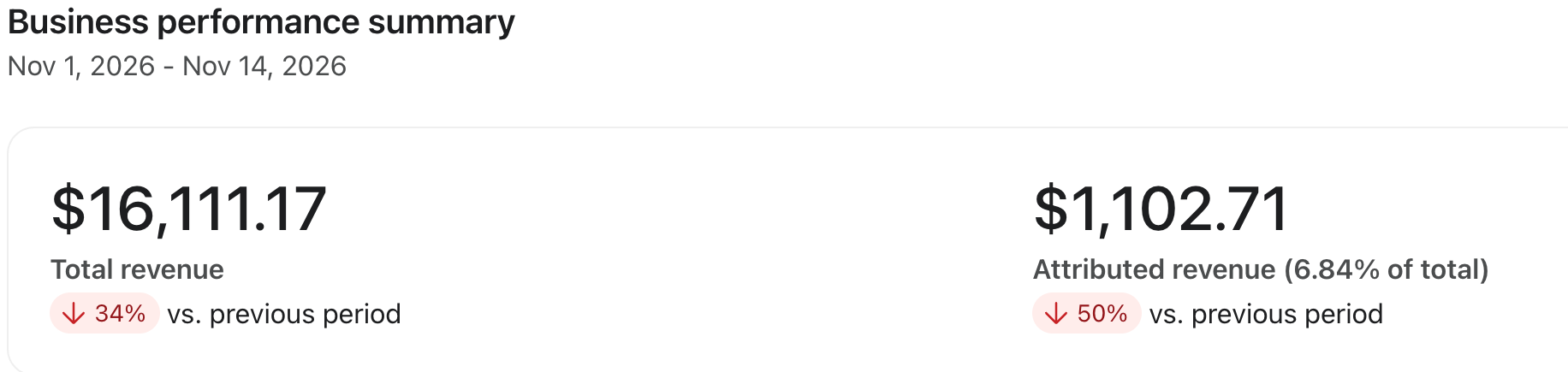
Total Revenue Fell 34% And The Revenue Credited To Email Fell 50%, Over The Same Two Weeks
the whole store: down 34%email: down 50%
Email fell further than the store did, and the store fell too…
…so before any email gets blamed, the first thing to settle is how much of that 50% comes from fewer people buying anywhere on the site, and how much from the window Klaviyo uses to credit email.
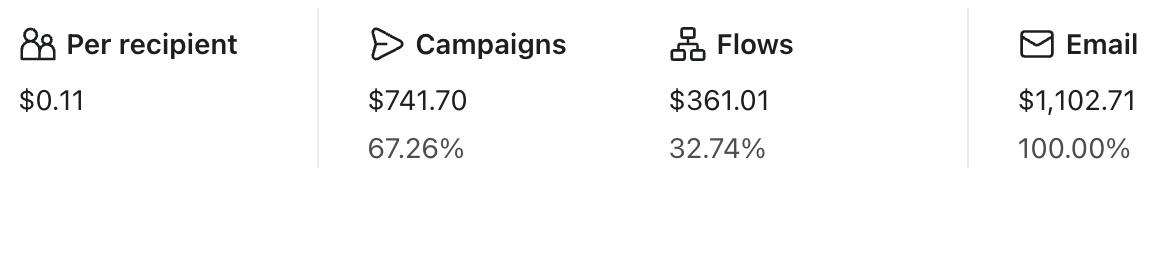
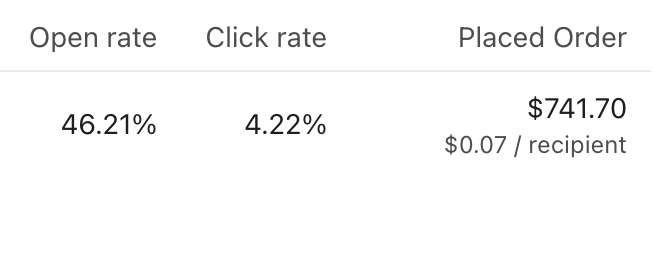
Two-Thirds Of The Email Revenue Came From One Campaign
two-thirds from campaigns
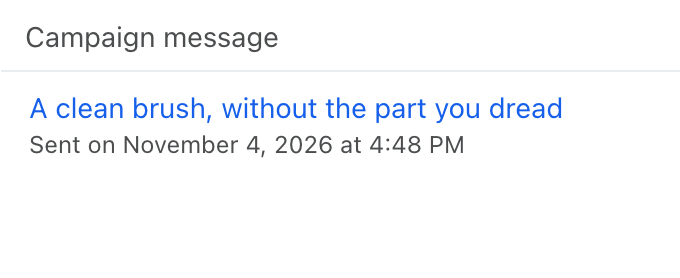
one send, Nov 4
all $741.70 of it
The only campaign listed for those two weeks went out on November 4, and it accounts for all $741.70 of the campaign revenue…
…so comparing this fortnight with the last one says as much about the campaign calendar as it does about the flows, which is why the Email Check reads campaigns and flows separately.
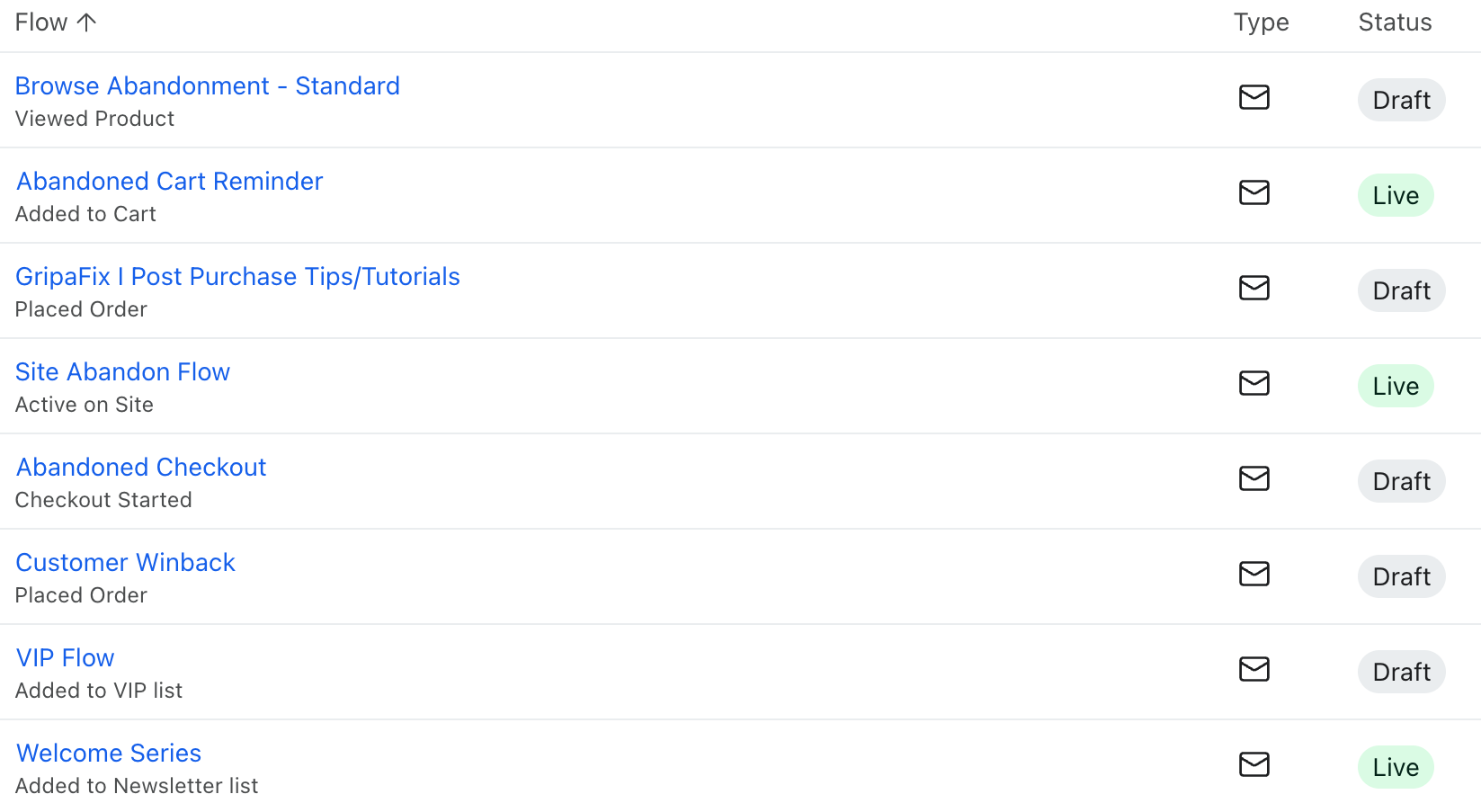
Five Of These Flows Are Sitting In Draft, Including The Abandoned-Checkout Flow
A flow in Draft isn't sending, so nothing written inside it can move a number until someone decides it should be live…
…and with the cart flow live and the checkout flow in Draft, the first check is which email, if any, the people who reach checkout are getting right now.
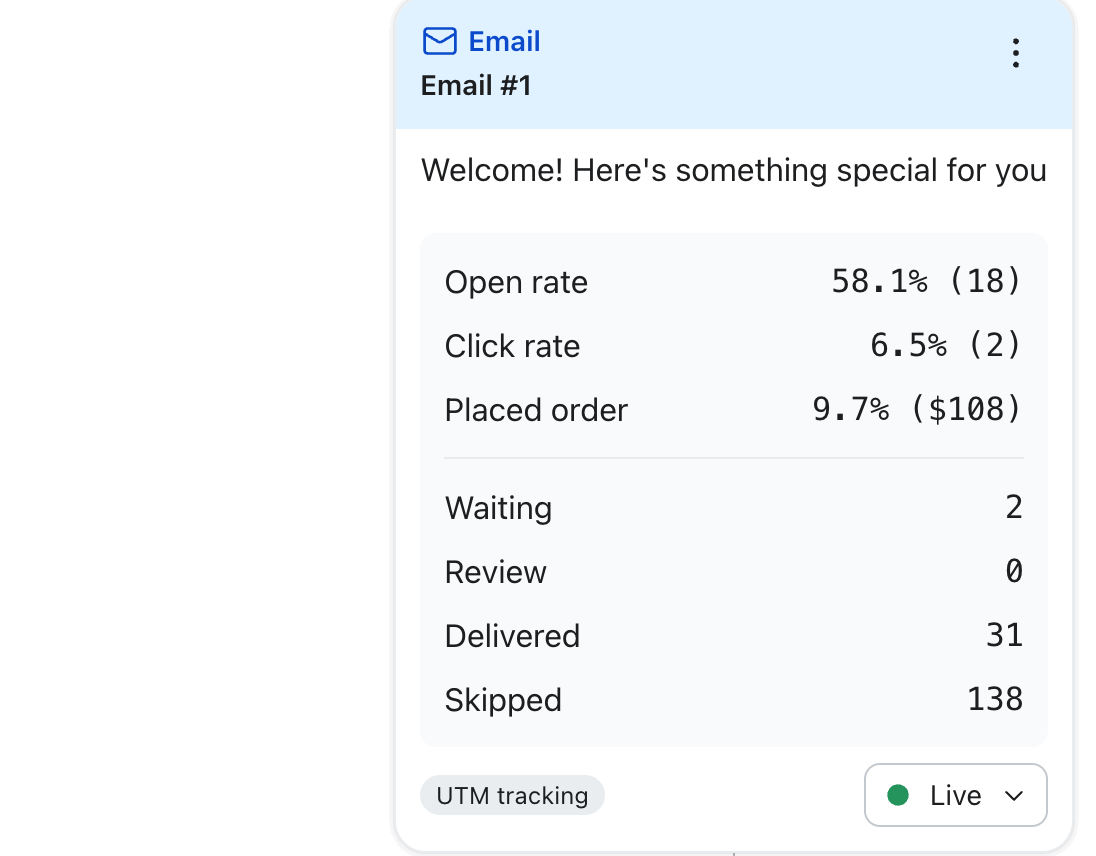
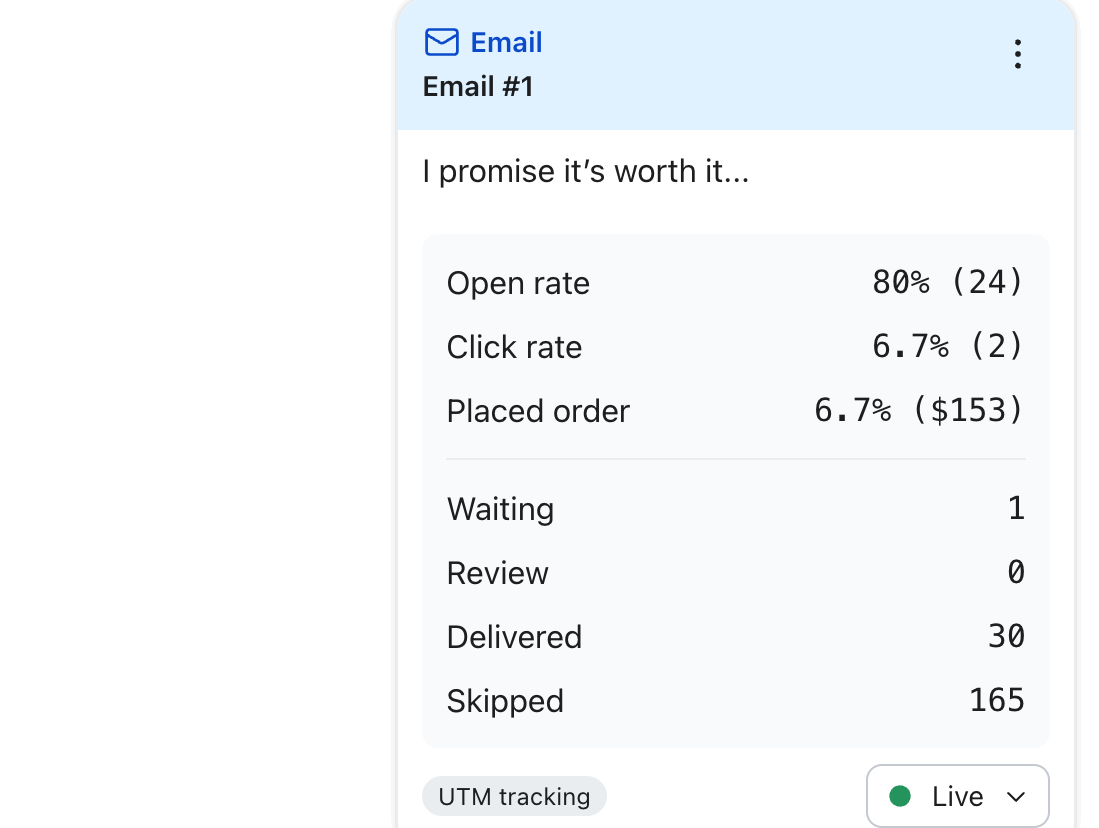
More Than Four Out Of Five People Who Reached These Two Emails Were Skipped
138 skipped, 31 delivered
165 skipped, 30 delivered
The cart email opened at 80% and brought in $153 from the 30 people it reached…
…so the writing is doing its job for the people who get it, and the bigger question is why 165 people didn't.
Klaviyo's Skipped tab lists the reason for each skip, whether it's Smart Sending, a flow filter or something else, and that's the first thing the Email Check reads in a flow like this.
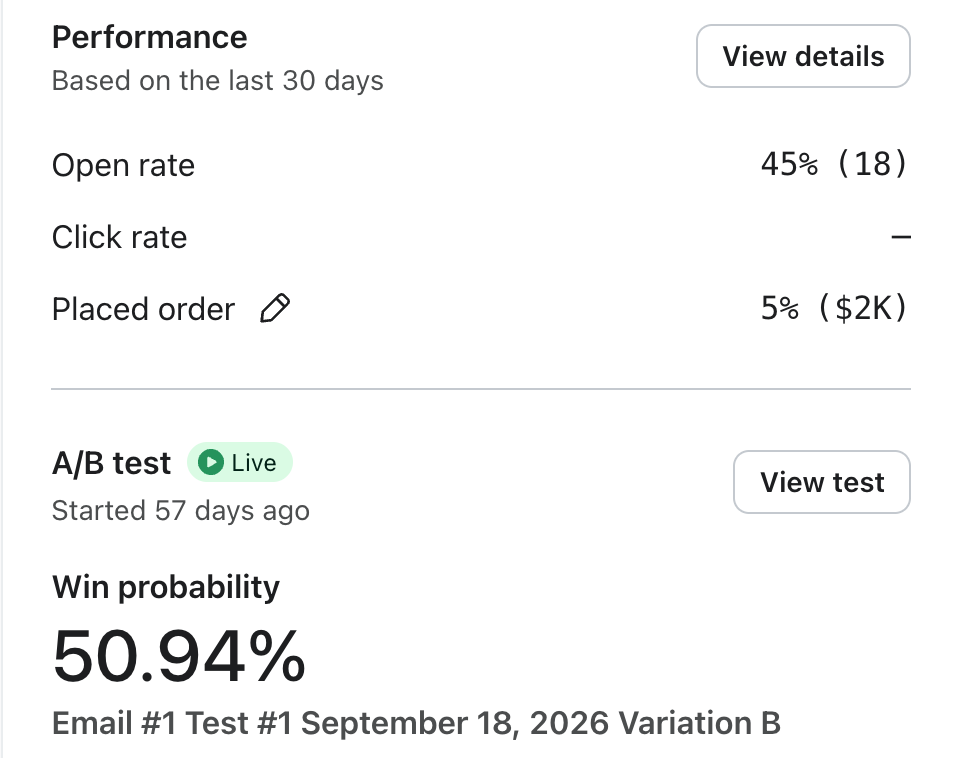
After 57 Days, This Checkout Email Test Reads 50.94%, Which Is Close To A Coin Toss
57 days instill close to 50/50
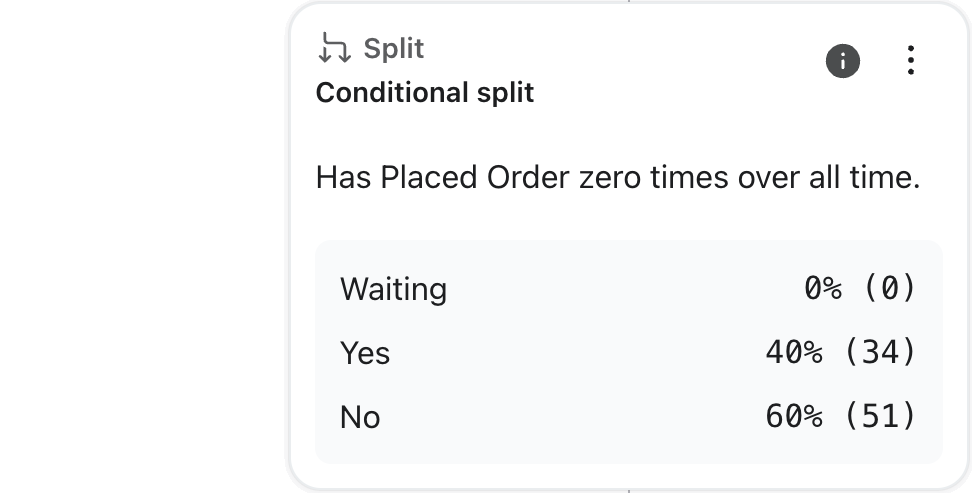
60% have ordered before
Picking variation B now would mean picking on a number that's barely off even…
…and the split beside it shows 60% of the people who started checkout had already placed an order, which changes who the checkout emails are talking to.
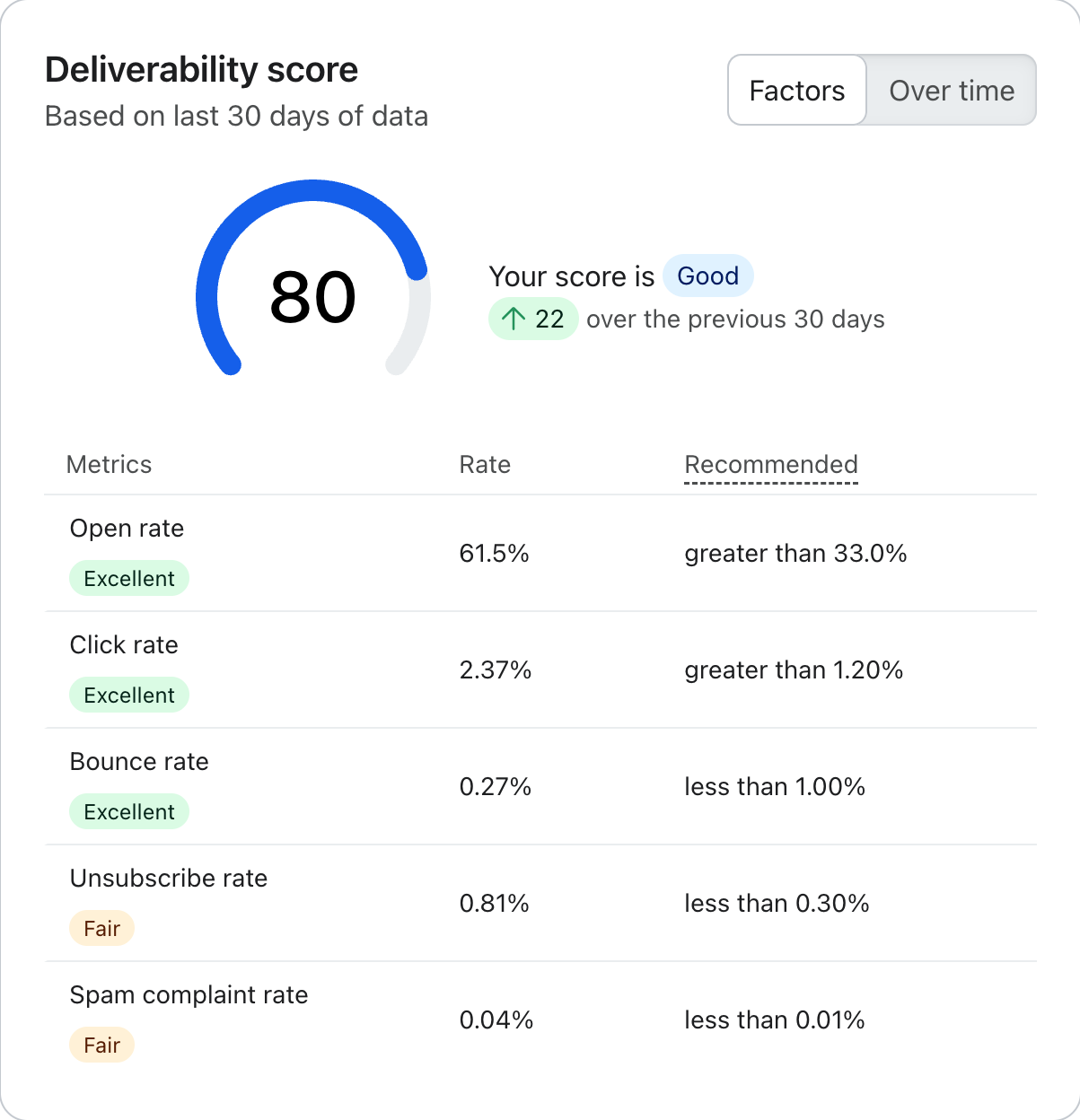
The Deliverability Score Says Good, And Two Of The Measures Under It Say Fair
overall: Goodthese two: Fair
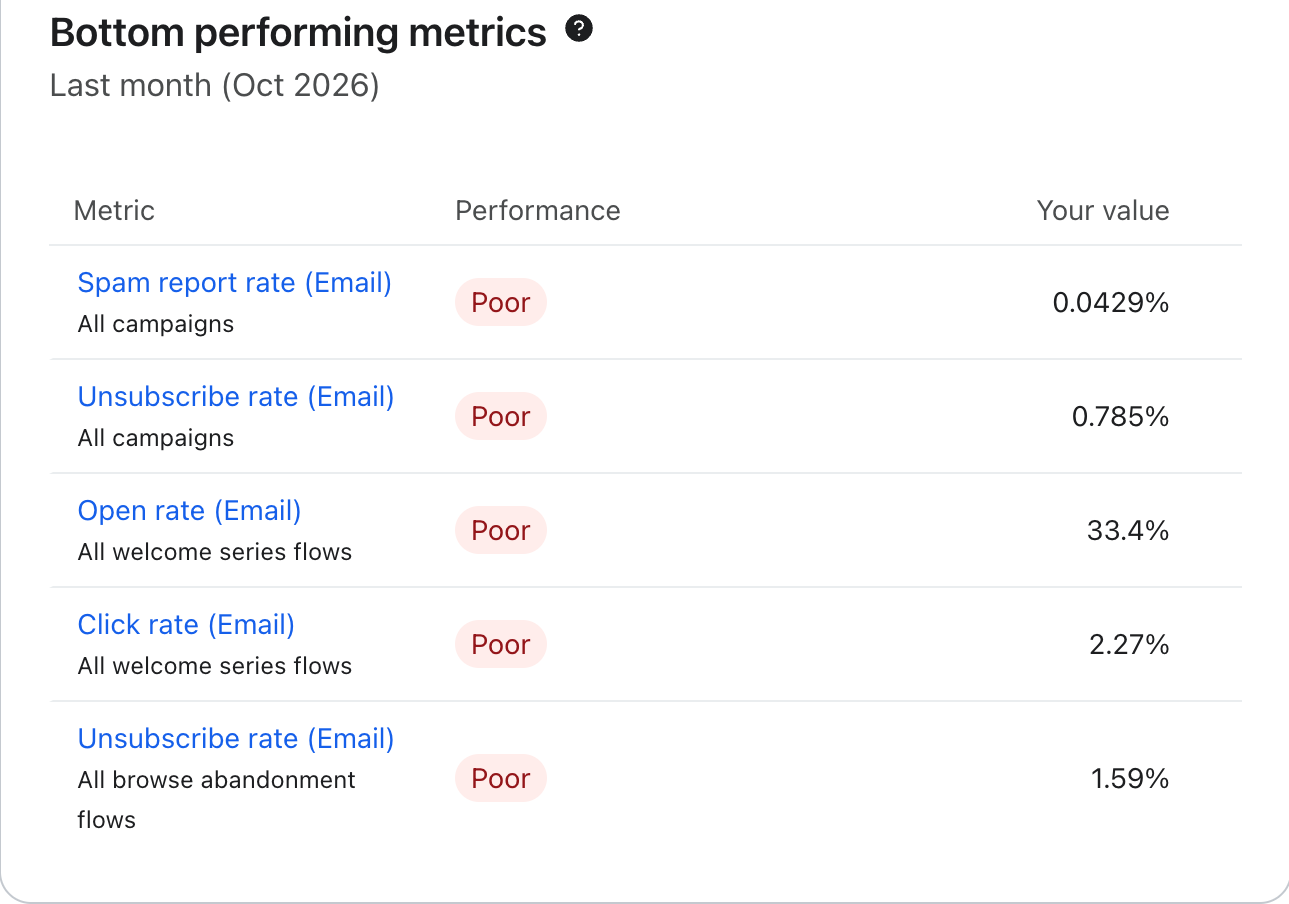
Unsubscribes sit at 0.81% against a recommended 0.30% or less, and spam complaints at 0.04% against 0.01% or less…
…so a good overall score can sit on top of a list that's reacting to what it's being sent, and the Email Check reads what went out in those 30 days before suggesting anything about the next send.
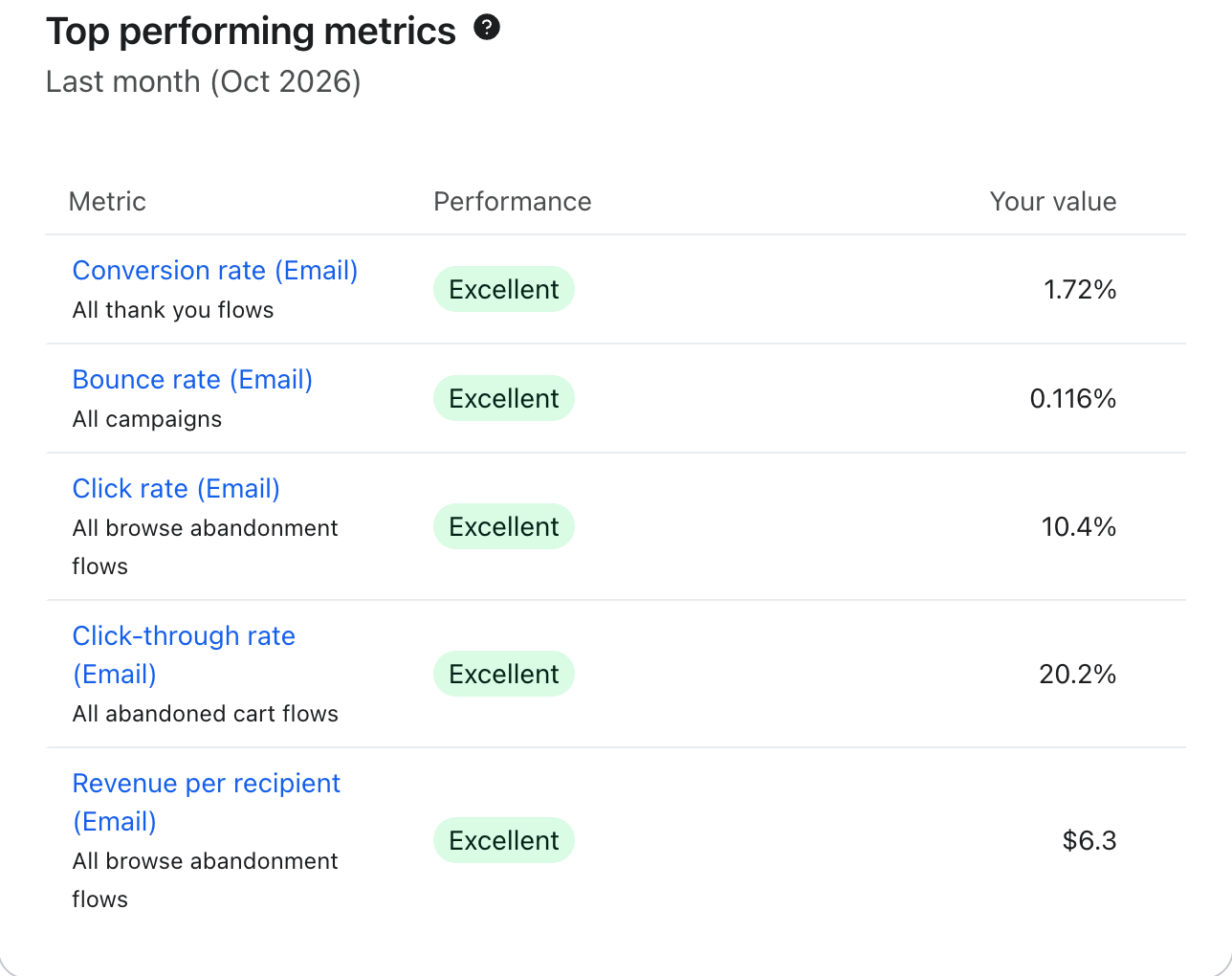
The Same Flow Shows Up As Excellent And As Poor On One Benchmark Page
browse flow: Excellent clicks
browse flow: Poor unsubscribes
Browse abandonment rates Excellent for clicks and for revenue per recipient, and Poor for unsubscribes, in the same month…
…so the label tells you where to look and leaves the cause out, and the Email Check goes into the emails behind both numbers before saying which one matters more for your store.
A New Template Changes How Every Email Looks At Once
a new look for every emailsame words underneath
That's useful when the look is the problem, and it's also why a template change on its own can't tell you which part of an email made the difference…
…so the Email Check reads what each email says and asks, and who it reached, before it looks at how the email is laid out.
One-time Klaviyo Email Check
Get The First Email Change Your Klaviyo Account Supports, Or The Check To Run First
One payment of $49
One call, written findings, a walkthrough and one email draft
Your findings arrive about two days after our call, in writing and on video.
Here's One Check You Can Run In Your Own Account Today
Open any email inside the flow you care about most, go to its Recipient activity tab and click Skipped (Klaviyo lists who was skipped there, with the reason beside each one).
When the skipped count is close to the delivered count, or higher, the writing in that email only ever reached the smaller group…
…and the reasons tell you where to look next, whether that's Smart Sending holding people back after a recent email, a flow filter or people who have unsubscribed.
That's one check on one email, and the Email Check runs the same kind of reading across the flows and campaigns that bear on your question, then puts what it finds in order.
The Questions Store Owners Ask About Their Klaviyo Accounts Sound Like This...
When store owners post about their email in public forums, the questions are mostly about which way to go next...
Here are some of them, close to how they were asked:
…Have Any Of These Crossed Your Mind?
Opens and clicks look steady, so why is the revenue Klaviyo credits to email falling? The campaigns look about the same as they did, and the dollar figure says otherwise.
What should I be sending when there's no promotion on and nothing new to launch? One campaign a month feels too few, and nothing obvious fills the space between.
Is it worth getting an audit, or should I work through it myself somehow? The flows are set up, and it's hard to know what an outside look would add.
Am I just emailing people who were never going to buy? The same cart email goes to someone who added one small item and left, and to someone who reached checkout with a full cart.
Why do thousands of opens turn into a couple dozen clicks? And why does the browse flow bring in close to nothing while the welcome series carries the month?
Should I send to a much smaller list? Cutting to recent clickers might lift the click rate, and nobody wants to give up revenue to get there.
Why did the newsletter bring more unsubscribes than sales? It went out every month, and the unsubscribes came in faster than the orders.
Is Klaviyo worth what it costs? The bill grows with the list, and a lot of that list hasn't engaged with anything in a long while.
Where did the open rate go? It sat in one range for a long stretch and then fell well under it this year.
Where do I start after a year of putting everything into ads? Klaviyo is set up with a welcome series and an abandoned-cart flow, and email hasn't had much attention since.
Here's Where The Usual First Moves Stop Answering Those Questions
Each of these makes sense on its own…
Rewriting the subject lines moves the open rate, and some of those opens are made by Apple's mail app on its own, before anyone has read a word.
Switching to a new template changes how every email looks at once, so when the number moves you can't say which part of the change moved it.
Adding another discount gives people a reason to buy this week, and it leaves open why last month's emails stopped bringing orders in.
Sending more often puts more emails in front of the same list, and when the cause sits in who's being skipped or where the click lands, every extra send carries that same gap with it.
A free audit from an agency can be thorough, and it comes from someone whose next step is a proposal, so it's fair to read it with that in mind.
Copying what bigger brands send borrows their calendar, and their subscribers came to them from somewhere different from where yours came to you.
Reading the benchmark page tells you a flow rates Poor or Excellent next to similar accounts, and it leaves out why, which is the part you'd act on.
Waiting it out works when the dip is seasonal.
Every One Of Those Moves Works Better Once You Know Which Cause You're Dealing With
And knowing the cause starts with reading the account in the order a shopper moves through it...
...from the moment they enter a flow to the page their click opens.
How The Email Check Reads The Path A Shopper Takes Through Your Emails
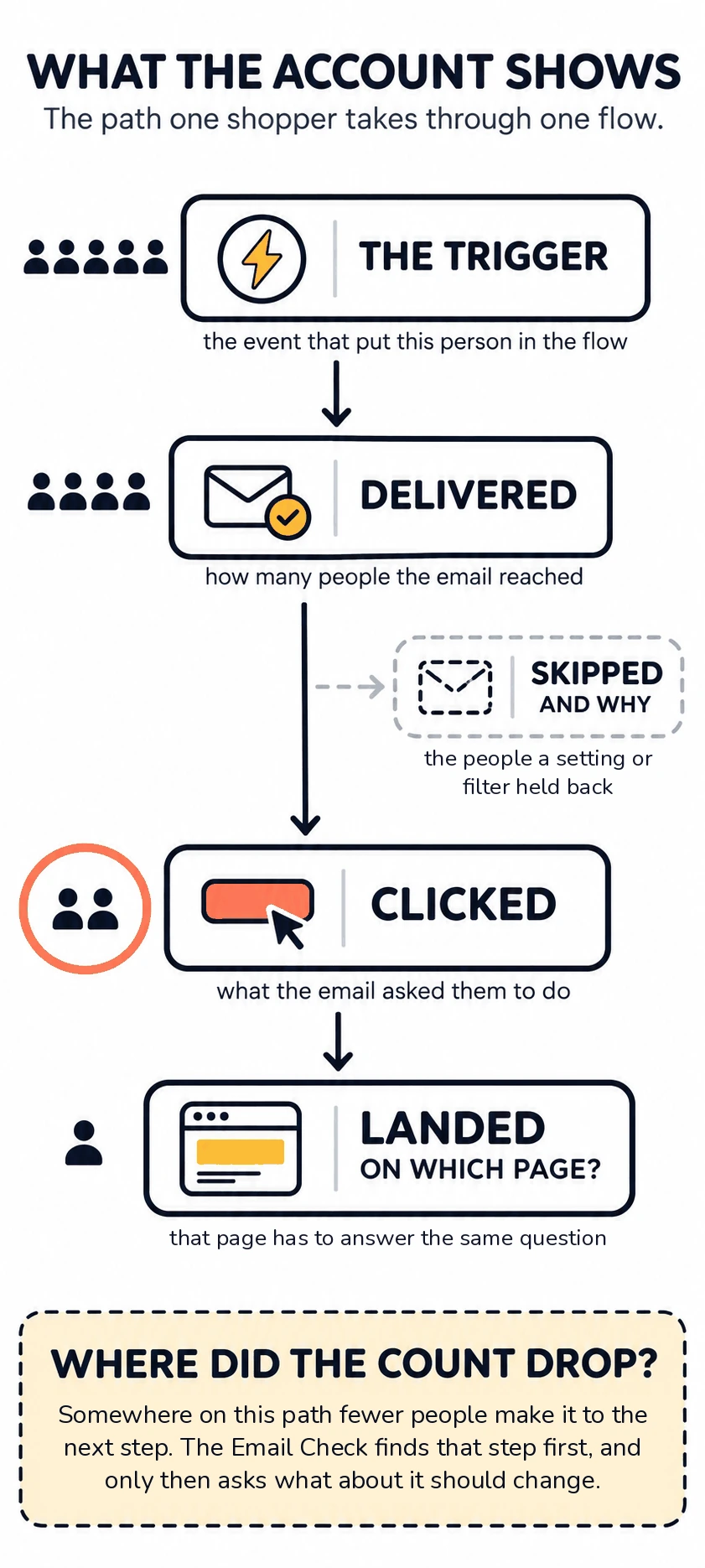
Every email in a flow sits on a path, and a dashboard number only tells you that something changed somewhere along it.
So the Email Check follows that path one step at a time…
...starting with what puts a person into the flow, then who received each email and who was skipped, then what the email asked them to do and where the click took them.
And once the step where the count drops is clear, the findings name the change that step calls for, or the check that has to come before it.
Here's The Path The Email Check Follows, From The First Trigger To Your Written Findings
Every step on it can be checked.
Why Reading The Account First Matters More Now Than It Did A Few Years Ago
A few things have changed in how email gets counted, and each one makes the dashboard easier to misread when a number gets taken at face value.
Opens are counted differently.Apple's mail app can load an email before anyone reads it.
Klaviyo's own help pages say this can make opens look higher than they are, and they give you a way to separate those opens out, so an open rate that holds steady can hold steady for reasons that have nothing to do with whether people read.
Revenue is credited inside a window. By default Klaviyo gives an order to the last email someone opened or clicked within a set number of days, five for new accounts, and each account can change that setting. So when the window changes, or when people take longer to buy, the email figure moves while the emails stay the same.
A setting can move that number on its own.
Flows skip people on purpose. Smart Sending, flow filters and suppressions all decide who gets each email, and Klaviyo lists every skip with its reason.
When more people are skipped than reached, the copy in that email only ever met the smaller group.
Benchmarks give you a label.Each flow gets rated Poor, Fair, Good or Excellent next to similar accounts.
And the label leaves the cause out, so it tells you where to look and leaves the deciding to you.
One-time Klaviyo Email Check
Get The First Email Change Your Klaviyo Account Supports, Or The Check To Run First
One payment of $49
One call, written findings, a walkthrough and one email draft
Your findings arrive about two days after our call, in writing and on video.
If you're ready, any button on this page books your call. If you'd like to know who's reading your account, here's how I came to work this way.
For The First Four Or Five Years I Wrote Email, I Sent The Same Message To Everyone, Because That's What The Advice Said To Do
When I started writing email, the advice I kept hearing was to build one strong template and send it to the whole list, so that's what I did, for my own work and for the people I wrote for.
…The results were poor, for me and for them…
…and I stayed with it for four or five years before I changed how I worked.
Then I Started Writing To Each Audience On Its Own, And Asking Where Each Person First Met The Business
Instead of one message for the whole list, I wrote to each audience separately…
…and traced every message back to the place where that customer first came across the business…
…because that's where their reason for being on the list began.
The First Place I Did It Was A Rug Store I Write For, Where The People On One List Had Arrived For Very Different Reasons
Some of them were furnishing a room and some wanted to see one color in their own light before deciding anything, and they'd come in through different doors, so one email was never going to serve both of them.
Once each group got an email written for the reason they arrived, the emails stopped reading like they were meant for everybody.
Real Estate Made It Even Clearer, Because Buyers And Sellers Read The Same Market From Opposite Sides
When I write for real estate agents, the buyers get one set of emails and the sellers get another…
and both change when the market shifts, because a seller's market and a buyer's market ask different things of each of them.
Each List Holds Different People
I've written that way for about ten top-producing agents, and it's the same lesson each time…
…one list holds several different people, and each of them needs to be written to as the person they are.
Then I Moved Into Shopify And Klaviyo, And Found The Same Thing Sitting Inside The Reports
A store owner would show me an account where the emails looked fine and a number had dropped…
and the first thing I'd ask was who that number was made of: who had entered the flow, who had received the email and where the click had taken them.
The Three Questions I Ask Of Every Email
Who receives it, what it helps them do and what happens next.
Those are the questions I bring to an account before I write a word for it, because the answer to the first one changes the other two…
…a person who just started checkout wants something different from a person who signed up for a discount code months ago, so an email written for one of them reads as noise to the other.
Why I Read An Account Before I Write For It
If I rewrite an email before I know who it reached…
…I can end up writing a better email for people who were never getting it...
…and the number stays exactly where it was.
It's Also Why The Emails I Write Are Plain, Short And Sound Like A Note From One Person To Another
A plain email gives the person reading it one thing, an answer to the question they have right now…
and when it does that well, the photos and product details can live on the page the link opens.
That's how I write for the stores and agents I work with, and it's how the email in your Email Check will be written.
And It's Why The Abandoned-Checkout Email In Your Email Check Is Written From What You Tell Me About Your Buyers
On our call I'll ask what people usually want to know before they buy from you, and what they ask your team after they've ordered.
Someone who started checkout has already picked something, so the email that follows them only has to answer what made them stop…
…and the draft is written to do that, in your voice, with the link straight back to the checkout they left.
You can send it as it is, give it to whoever runs your flows, or put it next to the one you have now and compare them.
I won't publish it or switch anything on in your account, because the decision about what goes live stays with you.
Sometimes The Honest Finding Is That An Account Doesn't Have Enough In It Yet To Say
When a flow has only had a handful of people through it, any change will look like it worked or failed by chance…
…so the findings will say that plainly and tell you the point at which it's worth reading that flow again.
Which Is Also Why This Email Check Costs $49 And Has No Retainer Attached To It
An Email Check that's priced to lead into a monthly contract has a reason to find plenty of work.
This one is priced as one finished piece, the call, the reading, the findings, the walkthrough and one email, paid for once.
If you'd like help with what comes after, I write and run email for stores, and you can ask me about that whenever you like…
…and if you'd rather do it yourself or hand it to your marketer, the findings are written so that works just as well.
What I Go Through, In Every Account, Before I Write Anything For It
These days, whether I'm writing a flow or reviewing one, I start from the same short list…
What made each person join the list
Which emails each of them actually received
What each email asked them to do, and whether it asked for one thing
Where the click took them, and whether that page answered the same question the email raised
Which numbers on the dashboard can be taken at face value, and which need a second look first
What the owner already knows about their buyers that no report will ever show
That list is the Email Check. It's the same reading I'd do before writing a single email for an account, done on the part of yours that bears on your question, and handed back to you in writing so you can act on it with me or without me.
The Usual Way, And The Way This Email Check Works
Usually a number falls and the first change goes into the emails.
In this Email Checkthe first step is finding where on the path the number fell.
Usuallya new template, a new subject line and a discount all go out together,so nobody can tell which one did what.
In this Email Check one change happens at a time, with the reason for it written down before it's made.
Usually an audit lists everything it found and the owner works out what matters most.
In this Email Check the findings put one priority at the top, or one check, and say what can wait.
Usually there's a questionnaire to fill in (before anyone opens the account).
In this Email Check a 30-minute conversation about your store is the only preparation it asks of you.
Usually someone asks for your password, or for full access to the account.
In this Email Check you add me with view-only access and no password changes hands,so nothing gets edited or sent.
Usually a finding says what's wrong and leaves you to work out what to write.
In this Email Check one checkout email comes already written.
One-time Klaviyo Email Check
Get The First Email Change Your Klaviyo Account Supports, Or The Check To Run First
One payment of $49
One call, written findings, a walkthrough and one email draft
Your findings arrive about two days after our call, in writing and on video.
Here's what that reading looks like on a real question…
…one a store owner asked in public about their own account.
An Owner Who'd Used Klaviyo For Over Two Years Saw Opens And Clicks Hold Steady While Email Revenue Fell, And Had Already Changed The Templates
They'd also checked that the offers in the emails matched the offers on the store, and the number still didn't move.
So they asked what to investigate first when engagement stays steady and the revenue credited to email drops.
It's a good question, and the template change had already answered part of it, because the number stayed where it was after the look of every email changed.
Here's where I'd start reading.
First the attribution window, because if that setting changed, or buyers are taking longer to decide, the email figure moves while the emails stay exactly the same.
Then the opens, with Apple's automatic opens set apart from the rest, because a steady open rate can be held up by opens nobody made.
Next I'd Follow The Click, Because Steady Clicks And Fewer Orders Can Mean Something Changed Between The Email And The Checkout
Where does each email send people, does that page still match what the email promised, and does the checkout still behave the way it did?
And Only Then Would I Ask Whether The Emails Need Rewriting, Because By Then There'd Be A Reason To
…If the window, the opens and the path after the click all hold up…
…then the emails are the part that's left, and the findings can say which email, which part of it and why, with the evidence beside it.
And if one of the earlier checks explains the drop, the emails can stay as they are.
A different owner asked whether an audit was worth it for an account with about 780 active profiles and six flows.
Someone who works in email replied that at that size an audit would mostly tell them what they already suspected, and that the flows were quiet because not enough people were reaching the triggers yet.
That reply was fair, and I'd say the same thing on our call…
…if your account doesn't have enough in it yet to say anything useful, you'll hear that from me before the Email Check goes any further, along with what to look at once it does.
An Honest Read Matters More To Me Than A Long List, Even When It Means Less Work For Me
A third owner had flows set up with proper tracking and sent maybe one campaign a month, because there wasn't always a promotion on or a new product to launch.
That's a different question from the first two, and it starts somewhere else...
...with the people on the list and what they want to know before they buy.
When you know the questions your buyers ask, the next campaign can answer one of them, and none of those emails needs a discount to have a reason to go out.
That's why our call spends most of its time on your buyers, and why the email draft in your Email Check is written from what you tell me about them.
Each Of Those Owners Needed A Different Part Of The Account Read First
Which is why the Email Check starts with the question you bring…
…and reads the part of the account that answers it.
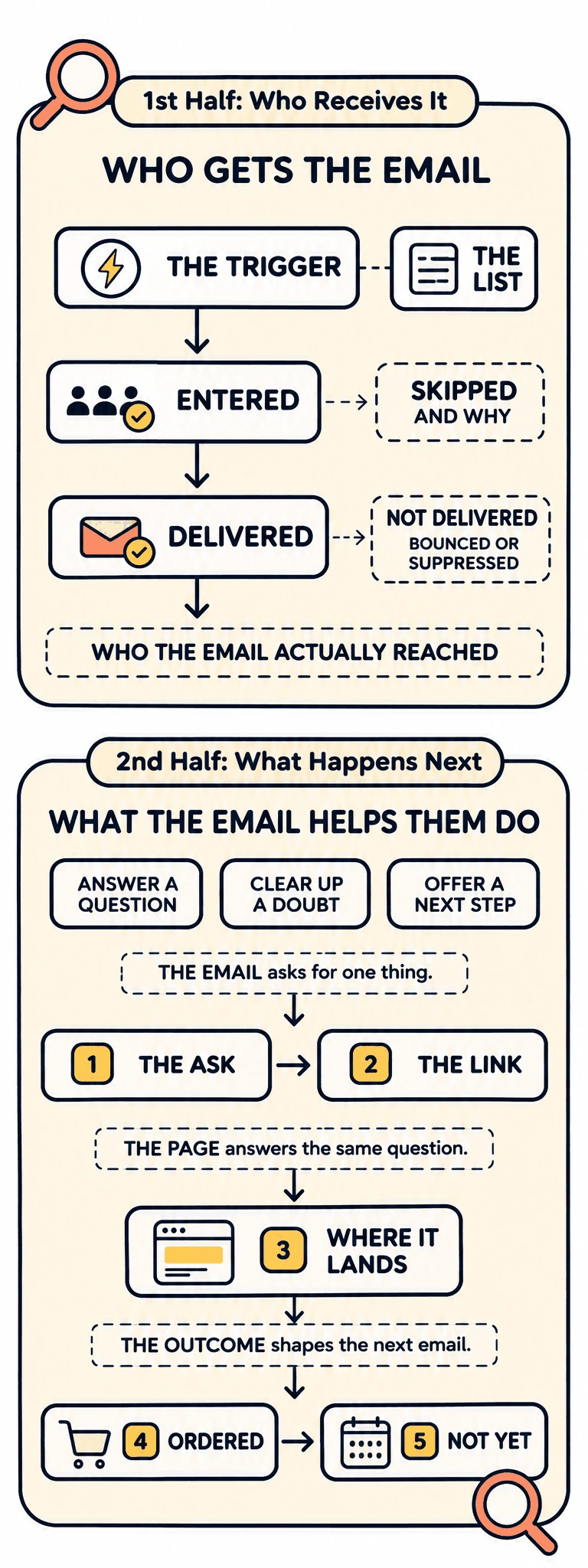
The Path Has Two Halves, Who The Email Reaches And What Happens Once They Open It
The first half is who gets each email…
…what put them in the flow, who was skipped and who it actually reached...
…and the second half is what the email asks of them and where they end up.
The Opens And Clicks Sit In The Middle Of That Path, Where The Most Visible Numbers Are
The email itself controls the middle, so that's the part a rewrite reaches…
…and the cause can sit at either end, in who received the email or in where the click landed.
So The Email Check Reads Both Ends Before It Touches The Middle, And Here's How That Looks
The top half is who receives the email.
…The bottom half is what happens after they open it.
The findings come from reading both halves together…
…with what you told me on the call sitting beside them.
Once Both Ends Are Read, The Middle Gets One Change With A Reason Behind It, Or It Gets Left Alone Until There Is One
One-time Klaviyo Email Check
Get The First Email Change Your Klaviyo Account Supports, Or The Check To Run First
One payment of $49
Your Email Check, from the call to the email draft
Your findings arrive about two days after our call, in writing and on video.
Part of what moves a flow's number sits one level below the dashboard, inside each message.
The Email Check Looks One Level Below The Dashboard, At Who Each Email Actually Reached
A flow's summary shows what it earned, and below that each message shows how many people it went to, how many were skipped and how many opened and clicked…
…so when a flow's revenue drops,the first question is whether fewer people reached it, or the same people reached it and did less.
Those two answers point at different changes.
Fewer people reaching it points at the trigger, the filters or the list…
…and the same people doing less points at the email, the offer or the page it sends them to.
Rewriting the email only helps in the second case, which is why the Email Check settles that question first.
Then It Reads What Each Email Asked The Customer To Do
Every email asks for something, even when it doesn't say so outright.
And the Email Check names what each one asks for:
Answer a question
Clear up a doubt
Offer a next step
Buy right now
Several of these at once
When an email asks for several things at once…
…the click has no clear place to go.
Read Who An Email Reached And What It Asked Before Changing A Word Of It
WHO IT REACHED
WHAT IT ASKED
Those two readings come before any rewrite, because together they tell you whether the words are the part holding the number back.
When they are, the findings say which words and why.
And Then It Follows The Click To The Page It Opens
…Because an email can be clear and still send people to a page that answers something else.
The Abandoned-Checkout Email Is Where All Of This Comes Together In One Message
The person it goes to started checkout, so you know exactly what they were about to buy and where they stopped…
…and the email only has to answer what held them back.
The draft in your Email Check is written to do that, from what you tell me your buyers ask before they buy, short, text-first and in your voice, with the link straight back to the checkout they left.
Twelve Places The First Priority Can Turn Up
Your findings will name the one that matters first in your account.
TRIGGER
FLOW FILTER
SMART SENDING
LIST HEALTH
SEND TIMING
SUBJECT LINE
THE ASK
THE OFFER
LANDING PAGE
CHECKOUT EMAIL
ATTRIBUTION
APPLE OPENS
27 Reasons An Email Check Sized To One Decision Suits A Store Owner Better Than Another Round Of Changes
Here's what you get from doing it this way:
1
You pay once, and nothing renews.
2
Your only homework is a 30-minute conversation about your own store.
3
Nobody needs your password.
4
Nothing in your account gets edited, scheduled or sent.
5
You get one first priority, so you know where to start.
6
Or one check to run first, when the evidence is too thin to act on.
7
The reasoning is written down, so you can follow it without me.
8
Your marketer can pick it up and act on it without a second meeting.
9
The walkthrough is recorded, so you can watch it again before you change anything, and pass it on to whoever runs your email.
10
The abandoned-checkout draft is yours to send as it is, edit or set aside, and it's written from what you tell me about your buyers.
11
It reads your account, so every finding is about your store and your list.
12
It keeps what the evidence shows apart from what's still a guess, so you know which parts you can lean on and which ones need checking first.
13
It says when a number can't be trusted yet, and why.
14
It sets Apple's automatic opens apart from the rest, so the open rate means what it should.
15
It checks your attribution window before it blames an email.
16
It follows the click all the way to the page it opens.
17
It counts who was skipped before it asks why people didn't click.
18
It gives you a reason you can repeat to anyone else who has a say in the store's email.
19
You keep control of every change, because you decide what gets made, when it gets made and who makes it.
20
You can stop after the Email Check with nothing more to buy, and nothing in your account will have changed.
21
If you want help with the work afterward, you can ask.
22
If you'd rather do it yourself, the findings are written for that.
23
If your store runs on something other than Shopify or Klaviyo, you can still book, and we'll go through what I can read in your setup.
24
The scope is set before you pay, so you know exactly what the Email Check covers, what it leaves out and what you'll have in your hands when it's done, and there's nothing to negotiate.
25
The price is set before you pay too, and it's the whole price.
26
The call gives you a second person looking at your question with you.
27
And the next decision gets easier to make, because you'll know how this one was made.
Put together, that's an Email Check sized to one decision…
…it reads the part of your account that bears on that decision, it tells you what the evidence supports, and it hands the next step back to you in a form you can use.
And once you have that, the email calendar, the flows and the discounts all have something to be measured against, because you'll know what you changed and why.
Here's what that looks like next to the way most changes get made:
When Each Change Is A Guess, The Account Fills Up With Changes Nobody Can Explain
A template change that may or may not have mattered
A discount that brought orders this week and left the question open
A flow rewritten twice that still reaches the same people
Once Each Change Has A Reason, You Can Tell What It Did
You change one thing, you know why you changed it, and the next report tells you something you can use whichever way it goes.
And When The Cause Sits Outside The Emails, Rewriting Them Costs More Than It Looks Like It Will
Every rewrite takes writing time…
…and when the cause is somewhere else, that time goes into the part that was already fine.
Writing time spent on emails that were working
Margin spent on discounts while the cause sat elsewhere
Extra sends carrying the same gap further
Another reporting window before you can tell anything
That's how the dashboard is built, since it reports what happened after each send and leaves the cause to whoever is reading it, so anyone working from it alone ends up guessing at some point.
And a guess that happens to land still leaves you guessing next time, because you never found out which part did the work.
The owners who post the questions you read earlier are paying attention, and they're asking exactly the right thing…
…they're asking it of a screen that was built to count, and the answer they want lives a level or two below it, in who received each email and where each click went.
Once you read it from there, the guessing has somewhere to stop:
Once You Know Where The Number Changed, The Rest Follows From It
You change one thing and know why
Your marketer gets a brief with the reason attached, so the work starts from where you're standing
Your writing time goes to the email the evidence points at, or waits until the evidence points at one
Discounts go back to being a choice you make for a reason
Apple's automatic opens stop getting read as interest
The next report tells you whether the change did what you expected, because it was the only thing that changed and you wrote down what you expected it to do
Your flows get read from the trigger all the way to the checkout, so the cause turns up wherever it sits
And the decision after this one starts from something you already know
So I Built This Email Check Around One Decision, For The Store Owner Who Wants To Know What To Change Before Changing It
I built it for the owner who already has Klaviyo running, with flows set up and campaigns going out, and a question about it they'd like answered before they put more time or money in.
You know your store and your buyers better than anyone, so what's useful is a second reading of the account that sorts what the numbers show from what they only seem to show.
A full rebuild would be more than that question needs…
…and a monthly retainer would be a bigger decision than the one in front of you.
So the Email Check is sized to the question, with one call, a set reading of the account and findings you can act on, for $49 once.
Here's how it's put together, and what each part covers…
It's One 30-Minute Call, A Set Reading Of Your Account And Three Things You Keep
Everything in it is set before you pay, so you know what you're getting and what you aren't.
Here's what each part gives you.
Here's Exactly What's In Your Email Check.
The Call30 minutes on your store, your buyers and your question.
View-Only AccessYou add me to the account, and nothing is edited or sent.
Up To Three FlowsRead from the trigger to the click.
Up To Three CampaignsWith about 30 days of your sending around them.
Written FindingsA first priority or a first check, with the reasoning.
Recorded WalkthroughThe findings explained, to watch again or share.
Checkout Email DraftOne abandoned-checkout email, written for your buyers.
Each part follows from the one before it…
…the call tells me what you're deciding,
the access lets me read the part of the account that bears on it…
…and the reading turns into your findings,
a walkthrough of those findings and one email written from what we covered.
Nothing in it asks more of you
than the call and adding me as a user.
That's The Whole Email Check, Built To Be Used By You Or Your Marketer
Once your findings arrive, you can act on them yourself, hand them to whoever runs your email, or ask me about the next step.
Here's How It Runs, From Booking To Findings:
Pick a time for your 30-minute call, and pay the $49 on the next page to hold it.
Talk with me about your store, your buyers and the decision you want settled, with your screen shared.
Add me to your Klaviyo account with view-only access, so I can read it without changing anything.
I read up to three flows, up to three recent campaigns and about 30 days of sending against what you told me.
You receive written findings, a recorded walkthrough and one abandoned-checkout email draft, about two days after our call once I have access.
Your Email Check Starts With Picking A Time That Suits You
One-time Klaviyo Email Check
Get The First Email Change Your Klaviyo Account Supports, Or The Check To Run First
One payment of $49
One call, written findings, a walkthrough and one email draft
Your findings arrive about two days after our call, in writing and on video.
Every part of the Email Check comes back to one question, which is what the evidence in your account supports doing next.
So each item below feeds the same place, the first priority or the first check at the top of your findings, with everything else in the Email Check there to back it up.
Here's Everything Your Email Check Will Show You, From The Call To The Email Draft
It's put together differently from an audit that lists everything it finds, because a long list of problems leaves you deciding where to start, and that decision is the one you came for…
…so the Email Check reads the same things a thorough audit would, and then it puts them in order, with one job at the top and the reason for it written beside it.
Some of what it finds will be worth doing later, and the findings will say so, so the later items don't crowd out the first.
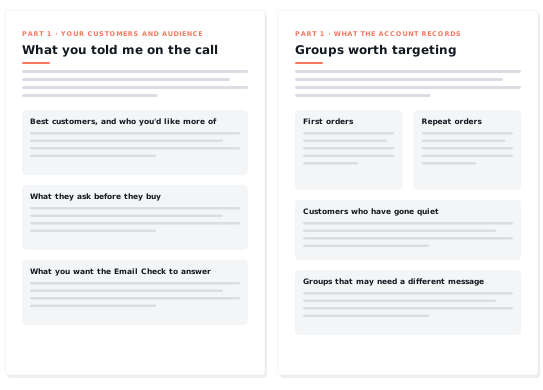
It Starts With What You Tell Me On The Call
The same number means something different in a store with one main product than it does in a store with a full catalog, and the call is where I learn which one I'm reading, who buys from you and what you want settled.
Then It Reads Your Flows, Your Campaigns And Your Signals, And Puts What It Finds In Order
Here's what you'll find across the call, the written findings and the walkthrough:
What you want settled, written as one question we can both check the account against. It keeps the whole Email Check pointed at your decision, so nothing in the findings wanders off into things you didn't ask about.
(On the call)
What your buyers ask before they buy (and after), which becomes the raw material for your abandoned-checkout email draft.
(On the call)
The customers you want more of (so the reading looks hardest at the part of the list that matters to you), whether that's first-time buyers, repeat buyers or people who've gone quiet.
(On the call)
What you've already changed and roughly when (so the Email Check doesn't hand you something you've done), and so the dates of those changes can be read against the numbers.
(On the call)
Which flows are live, which are sitting in Draft and which are switched off, and what that means for the revenue figure you're watching. A flow in Draft shows $0 for a reason that has nothing to do with its copy.
(Written findings)
What puts people into each flow you care about, and whether that trigger matches the moment the emails were written for.
(Written findings)
How many people each email reached, and how many were skipped before it sent, with the reasons Klaviyo gives for the skips.
(Written findings)
Where the skips point, so you know whether Smart Sending, a flow filter or the list itself is the place to look first.
(Written findings)
What each email asks the customer to doand whether it asks for one thing or several, because an email that asks for several gives the click no clear place to go.
(Written findings)
Where each click goes, and whether that page answers the question the email raised.
Whether your cart email and your checkout email each speak to the moment they fire on, since someone who added an item and someone who reached checkout are at different points.
(Written findings)
What your recent campaigns have been asking for, in order, so you can see the pattern a subscriber sees when they open one after another.
(Written findings)
How often you've sent over about 30 days, and who each send went to, so the campaign numbers get compared like for like.
(Written findings)
Which campaigns went to the whole list and which went to a segment (and why that matters when you put one campaign's numbers beside another's).
(Written findings)
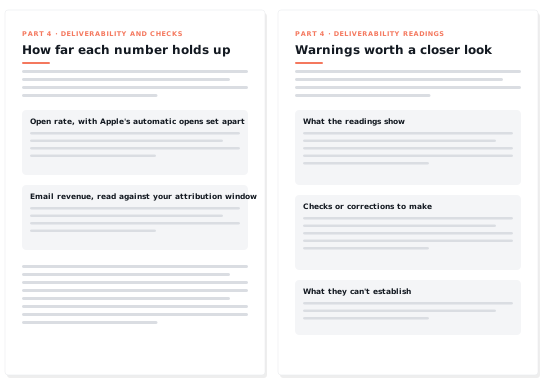
How much of your open rate comes from opens Apple's mail app made on its own, where your account separates them, so you know how far to trust the open rate.
(Written findings)
What your attribution window is set to, and what that does to the email revenue figure on your dashboard.
(Written findings)
What your deliverability page is telling youbeyond the overall score, including the measures underneath it that a good score can sit on top of.
(Walkthrough)
How your flows comparewith similar accounts on Klaviyo's benchmark page, and what that comparison can and can't tell you.
(Written findings)
Whether a test result is strong enough to act on, or close enough to even that it's worth running longer before you pick a winner.
(Walkthrough)
What the evidence shows, kept apart from what could explain it and what's still unknown, so you can see which parts of the reading carry weight.
(Written findings)
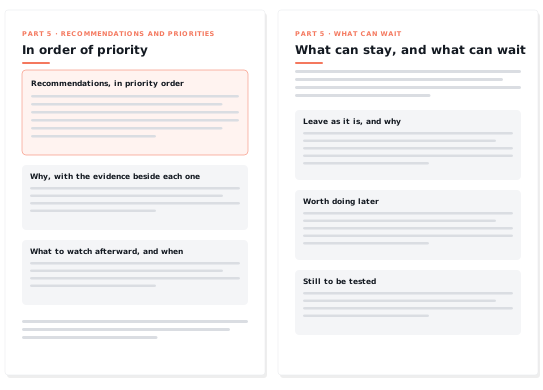
Your first priority, one change the evidence supports, with the evidence and the reasoning written beside it.
(Written findings)
Or your first check, when the evidence is too thin to act on, with what to look at and when it's worth looking again.
(Written findings)
What can wait, so the other things worth doing someday don't crowd the first job.
(Written findings)
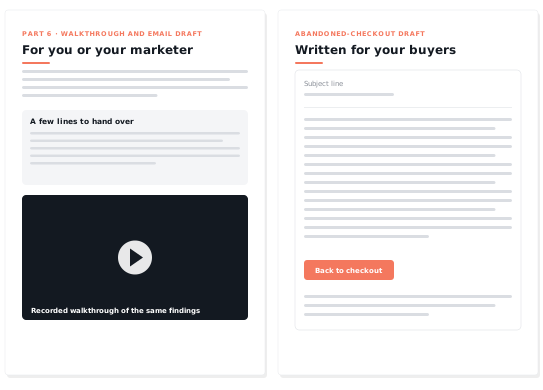
How to brief your marketer on it, in a few lines they can act on without a meeting.
(Written findings)
The reasoning behind each finding, on video, so you can watch it again or pass it on.
(Walkthrough)
One abandoned-checkout email (text-first and written for your buyers), ready for you to review.
(Email draft)
Once Your Email Check Arrives, You'll Be Able To...
Make your next email change with a reason you can say out loud
Hand your marketer one job with the evidence attached, and let them get on with it
Read your open rate with Apple's automatic opens set aside
Tell whether a falling number started in the email or somewhere around it
Leave a flow alone when the evidence clears it
Check whether a test has a real winner before you switch the whole flow over to it
Send an abandoned-checkout email written for your buyers
Decide what comes next on your own terms
There Is One Catch, And It's Worth Knowing Before You Book
The Email Check is sized for one decision, so it reads up to three flows and three campaigns, and it doesn't rebuild anything, manage your sends or repair deliverability settings…
…if the first priority turns out to be a technical deliverability issue, the findings will say so and point you toward the kind of help it needs.
And if your account doesn't have enough sending history to say much yet, I'll tell you that on the call, along with what to look at once it does.
What's Included, And What Isn't
The Email Check includes one 30-minute call, a view-only reading of up to three flows, up to three recent campaigns and about 30 days of sending, written findings with a first priority or a first check, a recorded walkthrough and one abandoned-checkout email draft.
It leaves out rebuilding flows, sending or scheduling emails, ongoing management, DNS or deliverability repair, and any promise of more revenue or a particular inbox tab.
If you'd like help with the work after the Email Check, you can ask me, and buying the Email Check never commits you to it.
There's No Countdown On This Page, Because A Decision About Your Email Is Best Made When You Have The Question In Front Of You
There's no deadline on this offer, and the Email Check is the same whether you book this week or later on.
The only limit is my calendar, because I do each call and each reading myself, so if the times you'd like are taken, the next open ones are on the booking page.
Book when there's a decision in front of you and you'd like the evidence for it.
Here's How To Book Your Email Check
Click any button on this page, pick a time for your 30-minute call and pay the $49 on the next page, and you'll see what happens next and how to add me to your account.
Jason
P.S. For the short version, the Email Check is $49 once, it starts with a 30-minute call about your store, and it ends with written findings that show you the first email change your account's evidence supports, or the check to run before you change anything, along with a recorded walkthrough and one abandoned-checkout email draft.
One-time Klaviyo Email Check
Get The First Email Change Your Klaviyo Account Supports, Or The Check To Run First
One payment of $49
One call, written findings, a walkthrough and one email draft
Your findings arrive about two days after our call, in writing and on video.
It's sized to one decision, so it reads a set part of your account rather than all of it, which means I can do it properly for one fixed price and you can judge the work before deciding whether you'd like anything more.
And it gives us both a way to see whether working together makes sense, with nothing owed either way once the Email Check is done.
What Your Findings Will Show You
Which of your flows are sending and which are sitting in Draft.A flow that has never sent shows $0 for a reason that has nothing to do with its copy, and the findings will list what's live, what isn't and what that means for the number you're looking at.
(Written findings)
Who entered each flow, and who was skipped before an email reached them. When more people are skipped than reached, the next step is finding out what skipped them, and the findings will tell you where to look.
(Written findings)
What each email asked the customer to do ( and where the click sent them), because an email can be clear and still hand people to a page that answers a different question. The walkthrough goes through it with you.
(Recorded walkthrough)
What the call covers (your store, your buyers and the one decision you want settled), in 30 minutes with your screen shared.
(On the call)
What your buyers ask before they buy, which becomes the starting point for the checkout email written for you.
(On the call)
One-time Klaviyo Email Check
Your Klaviyo Email Check For $49, Once
One payment of $49
One call, written findings, a walkthrough and one email draft
Your findings arrive about two days after our call, in writing and on video.
Which flows are live and which are in Draft, and what that means for the revenue figure you're watching.
(Findings)
Who each email reached, and who was skipped before it sent, with the reason for each skip.
(Findings)
Where the click goes, and whether that page answers the question the email raised.
(Walkthrough)
What each email asks for, and whether it asks for one thing or several at once.
(Findings)
Your open rate with Apple's automatic opens set apart, so you know how far to trust it.
What your attribution window is set to, and what it does to the email revenue figure.
(Findings)
Whether a test has a real winner, or is close enough to even that it needs longer.
(Walkthrough)
Your first priority, one change the evidence supports, with the reasoning written beside it.
(Findings)
Or your first check (when the evidence is thin), with what to look at and when.
(Findings)
What can wait, so the first job doesn't get crowded out.
(Findings)
A recorded walkthrough of the findings, to watch again or pass to your marketer.
(Walkthrough)
One abandoned-checkout emailwritten for your buyers, text-first and ready for you to review.
(Email draft)
What the Email Check leaves alonein your account, which is everything, since the access is view-only.
(How it works)
When your findings arrive, which is about two days after our call, once you've added me to the account.
(How it works)
What it costs, which is $49 paid once, with nothing that renews.
(How it works)
What you'll need ready, which is your question and a Klaviyo account with some flows already running.
(Before the call)
What happens if your account is small, which is that you'll hear on the call whether there's enough in it to say much yet.
(On the call)
Who it's for, the owner or the person who decides about the store's email.
(Who it's for)
What comes after, which is up to you, whether that's doing it yourself, with your team or with me.
(After the Email Check)
Stores not on Shopify or Klaviyo can still book, and we'll go through what I can read in your setup.
(Before you book)
How to book (pick a time, then pay on the next page).
(Before you book)
Why It's Only $49
It's sized to one decision, so it reads a set part of your account rather than all of it, which means I can do it properly for one fixed price and you can judge the work before deciding whether you'd like anything more.
And it gives us both a way to see whether working together makes sense, with nothing owed either way once the Email Check is done.
Your Klaviyo Email Check For $49, Once
One payment of $49
One call, written findings, a walkthrough and one email draft
Your findings arrive about two days after our call, in writing and on video.
$49, paid once, and nothing renews or commits you to anything after it.
What happens on the call?
We spend 30 minutes on what your store sells, who buys from you and the decision you want settled, and you share your screen so we can open the account together. I'll ask what your buyers usually want to know before they order, since that's what the checkout email draft gets written from. There's nothing to prepare beyond your question and the account itself.
Do you need my Klaviyo password?
No. You add me to the account as a user with view-only access, so I can read the account without editing or sending anything, and you can remove me whenever you like.
Will you change anything in my account?
No. Everything I find goes into your written findings, and what gets changed, when and by whom stays your decision.
When do my findings arrive?
About two days after our call, once you've added me to the account. You get them in writing, with a recorded walkthrough and the abandoned-checkout email draft alongside, so you can go through them at your own pace and share them with whoever runs your email.
What if my account is small or new?
Tell me on the call. When a flow has only had a handful of people through it, the numbers can't say much yet, and I'd rather tell you that than dress up a guess. You'll hear what's worth checking now and when the account will have enough in it to read properly.
My store isn't on Shopify or Klaviyo.
You can still book. Tell me what you use when you pick your time, and on the call we'll go through what I can read in your setup and what the findings will cover.
Do I have to hire you afterward?
No. The findings are written so you or your marketer can act on them, and you can ask me about more help whenever you like.
It's sized to one decision, so it reads a set part of your account rather than all of it, which means I can do it properly for one fixed price and you can judge the work before deciding whether you'd like anything more.
And it gives us both a way to see whether working together makes sense, with nothing owed either way once the Email Check is done.
On Your 30-Minute Call
Here's What We'll Cover
Your question. What you want settled, written in one sentence we can check the account against.
Your buyers. Who buys from you, what they tend to buy first and what they ask before they order.
Who you want more of, so the reading looks hardest at the part of the list that matters most to you.
What you've already changed, so the Email Check starts from where you are.
And Here's What Comes Back To You
Written findings with your first priority and the reasoning beside it.
A recorded walkthrough you or your marketer can go back to whenever you need.
One abandoned-checkout email written from what your buyers ask, ready for you to review.
Here's Everything That Comes With Your $49 Klaviyo Email Check
What The Email Check Covers
Everything the reading includes, set before you pay so you know exactly what you're getting.
Set scope
View-only
One 30-minute call about your store
Up to three flows read
Up to three recent campaigns read
About 30 days of your sending
Written findings with a first priority
A recorded walkthrough of the findings
One abandoned-checkout email draft
INCLUDED
Your Klaviyo Email Check
One 30-minute call and a view-only reading of your account, with written findings, a recorded walkthrough and one abandoned-checkout email draft.
One Email Check Of The Part Of Your Account That Bears On Your Decision
It reads up to three flows, up to three recent campaigns and about 30 days of sending against what you tell me on our call, and it hands back written findings, a recorded walkthrough and one abandoned-checkout email draft you can use whether or not you change anything else.
this is what you get
$49 Paid once, and nothing renews.
30 minutes On a call about your store, with your screen shared.
View-only Access, so nothing in your account changes.
The Call About Your Store
What you sell, who buys it and the one decision you want settled.
View-Only Access
You add me as a user who can read the account, so nothing gets edited or sent while I'm in it.
Up To Three Flows
Who entered, who was skipped and what each email asked.
Up to three of them, read with about 30 days of your sending around them.
Your Signals In Context
Purchase, engagement, deliverability and benchmark figures where your account has them, read for what they can and can't tell you.
Written Findings
One first priority, or one check to run first, with the evidence and the reasoning written beside it.
Walkthrough And Email
A recording that goes through the findings with you, and one abandoned-checkout email written for your buyers.
What Your Email Check Reads, Asks About And Hands Back To You
The Call
Your Question And Your Buyers
What you want settled, who buys from you and what they ask before they order, the customers you'd like more of, and what you've already changed.
Flows
Who Each Flow Reaches
Which flows are sending, what puts someone into each one, how many people were skipped before an email sent, and the filters and settings that held them back.
Flows
What Each Email Asks
Whether each email asks for one thing or several, where the click sends people, and whether your cart and checkout emails are each written for the moment they fire on.
Campaigns
Your Recent Sends
What your recent campaigns asked for, in order, how often you've sent over about 30 days, and who each send went to.
Signals
What Each Number Can Tell You
Apple's automatic opens, your attribution window, deliverability, benchmarks and test results, each read for what it can tell you and what it can't.
Findings
What Comes Back To You
One change the evidence supports or one check to run first, each finding explained on video, and one text-first abandoned-checkout email written from what your buyers ask.
One-time Klaviyo Email Check
Your Klaviyo Email Check For $49, Once
One payment of $49
One call, written findings, a walkthrough and one email draft
Your findings arrive about two days after our call, in writing and on video.
Store owners, or whoever decides about the store's email, who already have Klaviyo running with some flows in place and a question about it they'd like answered before changing anything.
What do I need to have ready?
Your question, your Klaviyo account and 30 minutes for the call. It helps to know roughly who your customers are and what they buy, and you don't need to write anything up beforehand, because the call is where that gets covered. After you book, the next page shows you how to add me to your account with view-only access. If your store runs on another platform, tell me when you book and we'll go through what can be read in your setup.
What does view-only access mean, exactly?
You add me as a user with a role that can read the account without editing, scheduling or sending anything. No password changes hands, and you can remove me from the account whenever you like, including the moment your findings arrive.
Will the Email Check tell me how much more I'll make?
No. It tells you what the evidence in your account supports doing next, and why. A revenue forecast would need things no Email Check can see, like your next product launch and what your buyers decide, so the findings stick to what the account shows.
Will plain-text emails get me into the Primary tab?
Inbox providers decide where an email lands, and nobody can promise you a tab. I write text-first emails because they answer the reader's question plainly, and the draft in your Email Check is written that way for that reason. If your deliverability page shows something worth looking at, the findings will say so.
What if the first priority isn't an email at all?
Then the findings will say so. Sometimes the first job is a setting, a segment, a filter or a flow that was never switched on, and you'll know which one, why and what to check after you change it.
Can I share the findings with my marketer?
Yes. They're written so whoever runs your email can pick them up and act on them, and the walkthrough explains the reasoning so they don't need a separate meeting with me.
What if I'd like help after the Email Check?
Ask me whenever you like, since I write and run email for stores, and buying the Email Check never commits you to it.